

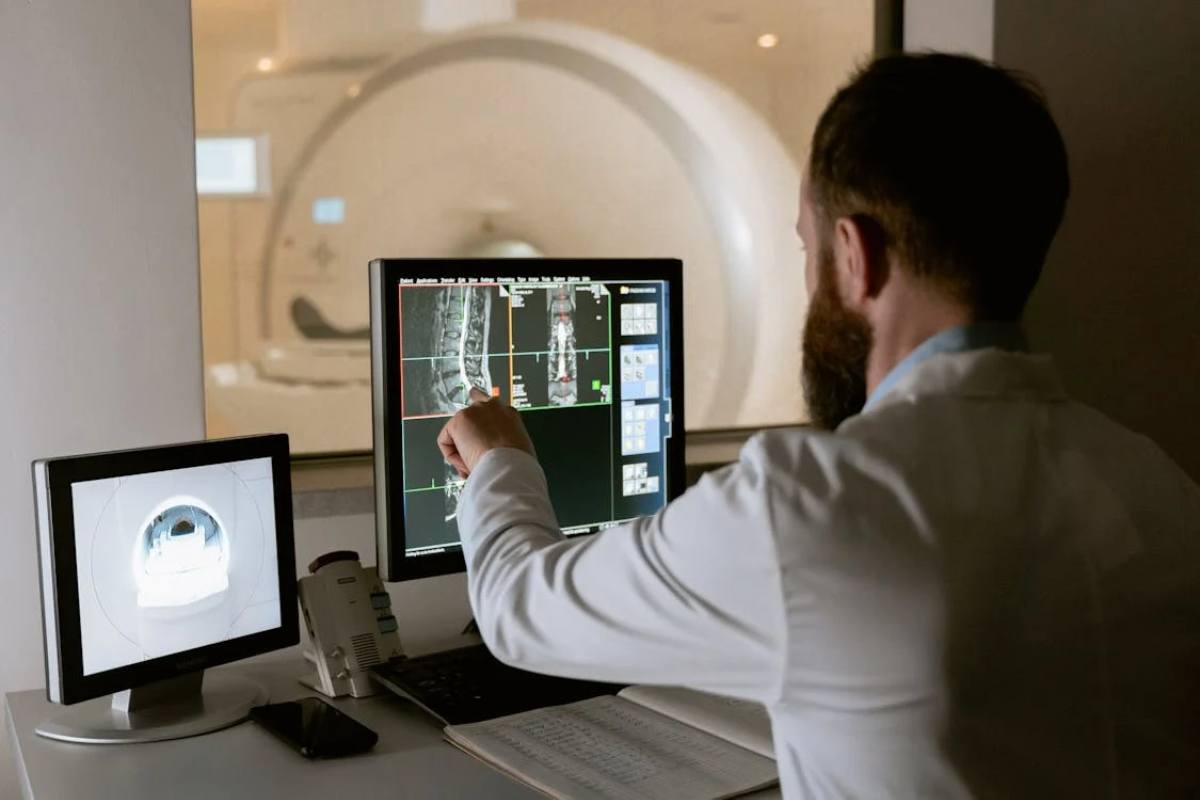
Today’s technological advancements and the drive to improve patient care, increase productivity, and reduce costs are rapidly healthcare technology
Advanced technologies such as telemedicine, blockchain, machine learning, and reproduction intelligence (AI) are at the forefront of these advances.
At the same time, healthcare technology software solutions are improving how healthcare services are optimised, data is managed, and patient communications are conducted.
Healthcare technology software companies are playing a critical role in exploring these advances. They help healthcare organisations use these technologies to improve patient outcomes and deliver better care.
Use the power of a healthcare software company to join the latest technology trends into your healthcare organisation.
Integrate AI, telemedicine, and the Internet of Things (IoMT) to improve clinical efficiency, protect patient data, and ensure a seamless care experience. Transform your healthcare services with customised solutions to meet your current needs and future challenges.
The Evolution of Healthcare Technology: A Market Overview
With a compound annual growing rate (CAGR) of 15.24% from 2024 to 2029, the medical technology sector is set to grow rapidly.
The drivers of this growth include the widespread use of smartphones, the growing need for remote monitoring, advances in medical information technology, and increased investment in e-health.
Insights from the Healthcare IT Market
Healthcare is undergoing a digital revolution, becoming a critical global medical information and services conduit.
Organisations are experimenting with wearables, telemedicine platforms, and mobile apps to improve the efficiency of healthcare delivery. This will allow patients to receive medical care from virtually anywhere in the world.
First of all, the healthcare IT infrastructure is rapidly changing. Hospitals and clinics implement various solutions such as digital imaging technologies, telemedicine systems, electronic health records (EHRs), and automated medical examinations.
These advances aim to improve patient consequences and streamline processes, fundamentally changing the approach to healthcare delivery. Companies must keep up with the latest advances in medical technology, embrace new ideas, and provide exceptional patient care.
Notable Emerging Digital Trends in Healthcare You Can’t Ignore
Artificial Intelligence and Machine Learning in Healthcare
The use of AI and ML in healthcare technology is one of the most significant changes. These technologies have shown great promise in predictive analytics, personalized medicine, and diagnostic accuracy.
AI can analyse large data sets, such as medical photographs or patient records, to identify trends that human doctors might otherwise miss.
AI and ML can be used for:
- Diagnostic support: AI algorithms help pathologists and radiologists detect illnesses like cancer more accurately and earlier. This technology improves diagnostic accuracy by identifying subtle patterns in test results and medical images.
- Predictive analytics: By assessing patient risks, AI-based predictive models enable early intervention for chronic diseases like diabetes and cardiovascular disease. By predicting patient load and optimising staff allocation, predictive analytics also helps healthcare organisations manage hospital resources.
Healthcare software companies enable healthcare organisations to implement advanced solutions that improve clinical decision-making and operational efficiency by integrating AI into their platforms. These programs help healthcare providers monitor patients in real time and provide predictive data.
Telemedicine and Virtual Healthcare
- The implementation of telemedicine has been accelerated by the COVID-19 pandemic, which has allowable patients to receive medical care remotely.
- Virtual consultations have become commonplace in healthcare, continuing a trend that began during the pandemic. Telemedicine improves care access, especially for patients in rural and disadvantaged areas.
The main benefits of telemedicine include:
- Greater accessibility: Patients no longer need to travel to see a doctor; they can do so from their home. This is predominantly beneficial for patients with limited flexibility or those living in remote areas.
- Cost-effectiveness: Health systems can reduce costs by using virtual consultations and minimising hospital visits. Additionally, telemedicine reduces the burden on outpatient clinics and emergency departments.
Telemedicine platforms, often developed by healthcare software companies, flawlessly integrate with electronic health records (EHRs) to enable healthcare providers to access patient data during virtual visits instantly. The efficiency of virtual care is enhanced by these systems’ scheduling, billing, and patient tracking capabilities.
Internet of Medical Things (IoMT) and Wearable Devices
By using the Internet to connect various medical devices to healthcare systems, the Internet of Medical Things (IoMT) is transforming patient care.
It enables real-time data collection from wearable devices such as fitness trackers, glucose monitors, heart rate monitors, and continuous health monitoring.
IoMT and wearable technology have various benefits.
- Remote patient monitoring: Even if the patient is not hospitalised, healthcare professionals can monitor their vital signs and other health indicators in real-time. This is especially useful in handling chronic illnesses such as diabetes and hypertension.
- Proactive care: By regularly monitoring health data, doctors can identify early signs of deterioration and take action before the situation worsens. As a result, the patient care paradigm has shifted from reactive to proactive.
Handling the vast quantities of data fashioned by IoT plans requires healthcare software solutions developed by software companies. To improve patient outcomes, these companies provide systems that allow healthcare professionals to instantly access this data, evaluate it, and take appropriate action.
Blockchain for Secure Data Sharing
Since medical records are sensitive, data security is a primary concern in healthcare. Blockchain technology solves this problem by ensuring that medical records are secure, tamper-proof, and accessible only to authorised users.
Blockchain technology safeguards the integrity of patient data by creating a decentralised record that cannot be altered without consent.
The part of blockchain technology in the healthcare sector includes:
- Data security and privacy: Blockchain technology enables secure storage and sharing of patient data, including electronic health records (EHRs) and personal health information (PHI), reducing the probability of data breaches and unauthorised access.
- Interoperability: Blockchain technology facilitates data sharing between healthcare organisations and providers, ensuring seamless communication and reducing errors caused by missing or fragmented data.
Leading healthcare software companies are integrating blockchain technology into their healthcare solutions by developing secure data storage and sharing platforms. These solutions protect patient privacy and ensure healthcare professionals comply with legal regulations.
Cloud Computing in Healthcare
Cloud healthcare solutions offer a scalable, adaptable, and reasonable way to store and manage large amounts of medical data, which is why they are becoming increasingly popular.
With cloud computing, healthcare providers can collaborate with other organizations, access data from anywhere, and reduce on-premises IT infrastructure costs.
The benefits of cloud computing include:
- Scalability: Cloud solutions are ideal for managing variable patient volumes or storing large amounts of data, such as medical photographs, because they can be scaled up or down based on demand.
- Collaboration and data sharing: Cloud systems help healthcare providers share data in real time, improving care coordination and reducing the likelihood of errors in patient transfers.
Cloud healthcare solutions are a speciality of many healthcare software companies, offering platforms that enable seamless collaboration between patients, healthcare providers, and other investors. These companies also ensure that their products comply with strict health legislation such as the Health Insurance Portability and Accountability Act (HIPAA).
5G and the Internet of Medical Things (IoMT)
The Internet of Medical Things (IoMT) will be driven by the deployment of 5G networks as healthcare trends change.
The high-speed, low-latency 5G connection enables faster, more reliable remote healthcare, essential for transmitting real-time data from connected devices.
5G will impact healthcare in several ways:
- Improved remote monitoring allows wearables and IoT devices to send data to healthcare professionals more efficiently. This enables faster treatments thanks to faster connections.
- Advances in telemedicine: 5G will streamline telemedicine consultations by offering better voice and video quality for online doctor visits.
Healthcare software companies are developing solutions that streamline the management of connected devices. As healthcare systems adopt IoMT and 5G technologies, these solutions will provide healthcare professionals instant data access.
Robotic Process Automation (RPA)
Patient registration, billing, and claims processing are repetitive, rule-based processes in a healthcare management system. Robotic process automation (RPA) can efficiently automate these tasks.
By automating these operations, healthcare organisations can increase productivity, reduce errors, and free up their staff to care for patients.
Healthcare RPA use cases:
- Claims processing: RPA streamlines and improves billing accuracy by automating the claims processing process.
- Patient booking: RPA optimises resource allocation, reduces no-shows, and simplifies the appointment process.
RPA-based healthcare software solutions help organisations reduce administrative costs and improve patient satisfaction. Healthcare professionals can focus on bringing high-quality care by automating labour-intensive procedures.
Virtual and Augmented Reality in Healthcare
Healthcare is being revolutionised by virtual reality (VR) and augmented reality (AR). These technologies are having a particular impact on hospital rehabilitation, surgery, and medical education.
These immersive technologies offer interactive learning opportunities and new ways to visualise complex medical processes.
Applications of AR and VR in healthcare include:
- Medical training: Virtual reality (VR) simulates surgical procedures, reducing the likelihood of errors during real procedures.
- Surgical assistant: By superimposing digital data on the patient throughout the procedure, AR provides surgeons with real-time guidance.
Healthcare software companies are creating AR and VR platforms specifically designed for medical applications. These platforms are designed for training, surgery, and patient rehabilitation.
Wrapping Up
Patient care is flattering more efficient and effective thanks to the industry’s transformation driven by rapid technological advances in healthcare.
Rapidly evolving trends in healthcare technology drive these changes. These trends require healthcare software solutions and healthcare software companies to implement them.
Blockchain, IoT, artificial intelligence, and telemedicine are transforming healthcare and improving patient outcomes. Hire a good healthcare software company to achieve the best results.
By anticipating these changes, healthcare organisations can optimise their operations and deliver better services.
Healthcare software companies are key in ensuring that healthcare systems are future-proof. They create the platforms and tools needed to drive the industry forward.